How to Improve Mental Health for Journalists: A UK Guide to Reducing Stress and Preventing Burnout
Ten ways journalists can protect their mental health: limiting trauma exposure, boundaries with the news cycle, recovery routines and asking for adjustments.
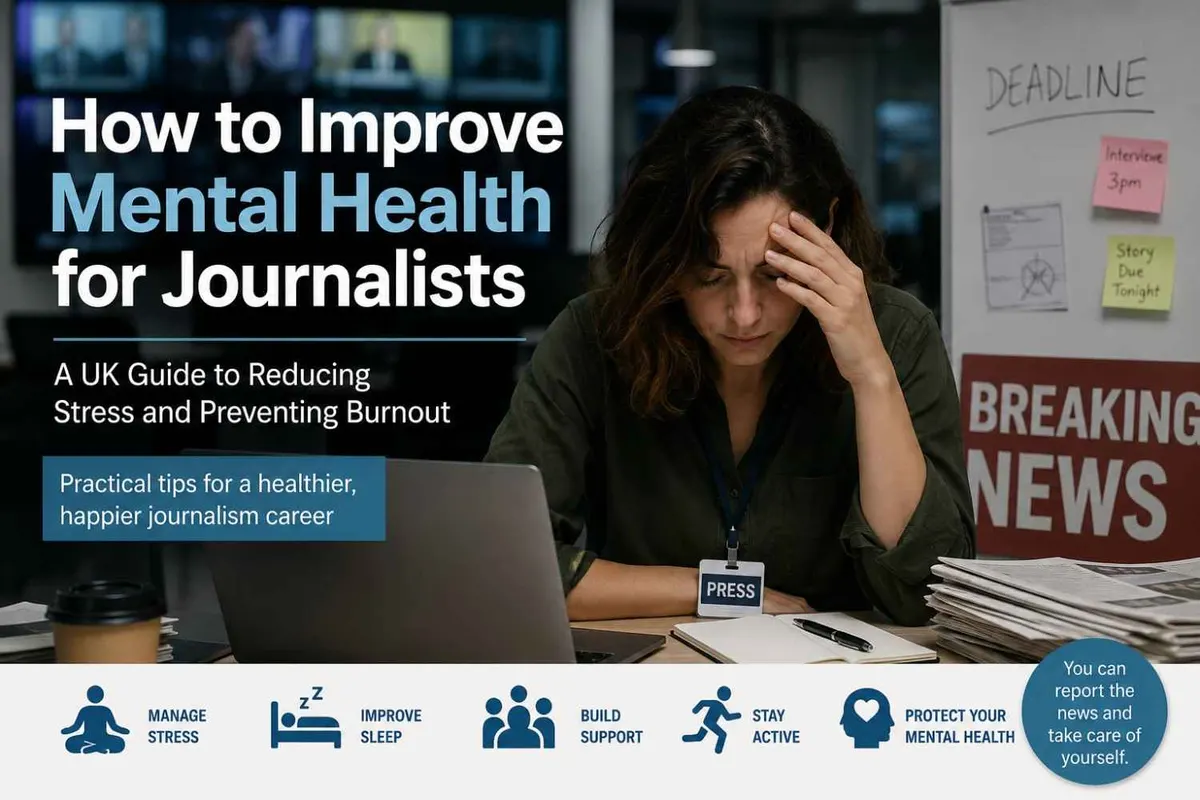
Journalism keeps the public informed, but the work can take a serious toll on mental well-being. Tight deadlines. Breaking news. Experiencing tragic events. Online harassment. Long working hours that intrude on personal time. For many journalists in the UK, this pressure doesn’t come occasionally; it’s part of the rhythm of the job.
That’s why improving mental health is not a secondary concern for journalists. It’s part of doing your job well. Prolonged stress can lead to poor concentration, sleep problems, and difficulty making decisions. The good news is that even small, practical changes can make a meaningful difference.
This guide shows how to Improve Mental Health for Journalists.
Why journalists are at higher risk of stress
Stress in journalism often builds silently. It starts with one night of work, then another, and then a week of endless notifications and unfinished drafts. Over time, this stress can become normal.
Journalists are more likely to encounter the following steps:
- Deadline pressure. As a result, there is very little time for rest between tasks.
- Exposure to distressing stories, including trauma, grief, conflict, or crisis coverage.
- Digital overload from social media monitoring, message alerts, and constant updates.
- Online criticism and harassment are especially prevalent for high-profile or opinion-led reporting.
- Irregular hours that disrupt sleep, meals, and family life.
- Job insecurity for freelancers and early-career journalists.
Signs your mental health may need attention.
Not every stressful week means a mental breakdown. Still, it’s helpful to be aware of when stress is turning into something more long-lasting.
Common warning signs include:
- Persistent fatigue even after sleep,
- Lack of concentration or making more mistakes than usual,
- Irritable mood, lack of emotion or lack of emotion,
- Rapid thinking or constant worry,
- Changes in appetite or sleep,
- Withdrawing from friends, colleagues, or family,
- Fearing tasks that once seemed easy.
When these symptoms persist for weeks, they should be taken seriously. It is usually easier to take action early than to wait until everything feels unbearable.
How to improve mental health for journalists
1) Protect your sleep like it is part of the job
Sleep is one of the strongest foundations of mental well-being. When journalists work late into the night, watch the news before bed, or keep their alerts on all night, their brains never fully shut down.
Try this instead:
- Set a regular wind-down time, even on busy days.
- Turn off non-essential notifications at night.
- Avoid caffeine too late in the day.
- Keep your bedroom dark, quiet, and cool.
- Use a simple pre-sleep routine: wash, read, breathe, sleep.
2) Set boundaries with the news cycle
News travels fast, but your nervous system isn’t designed to be on high alert all day. The healthiest journalists aren’t the ones who are always available; they’re the ones who know when to step back.
Effective boundary concepts in real life:
- If possible, set aside specific times for work.
- Have one phone or app for work and another for personal use.
- Set a time to not watch the news during mealtimes or before bed.
- Stop watching the latest news unless absolutely necessary during your vacation.
- Mute or filter out non-urgent alerts.
This is especially important for freelancers, who often feel the pressure to be available 24/7. A boundary doesn’t mean a lack of commitment. It’s a safety net.
3) Reduce trauma exposure where possible
Some reporting is inherently emotional. Covering tragic events, violence, or human suffering can be emotionally charged, even when the reporting is presented professionally.
When the task is difficult, try to avoid unnecessary contact.
- Limit repeated viewing of graphic material.
- Break up difficult tasks into shorter blocks.
- Debrief with a trusted colleague after demanding assignments.
- Ask for a rotation when coverage becomes too repetitive or intense.
- Notice your reaction rather than pushing through on autopilot.
A trauma-aware workplace is not about avoiding difficult journalism. Its main purpose is to protect those who do it.
4) Build a simple recovery routine after intense shifts
A conscious effort is needed to refresh the mind after a hard day of work. Otherwise, the stress of work can spread to the next day and the day after that.
A useful recovery routine might include:
- Take 10 minutes away from screens.
- Drink water and eat something balanced.
- Walk outside, even briefly.
- Write down the next action for tomorrow.
- Do one calm activity before sleep, such as reading or stretching.
Small recovery habits help the body get out of “alert mode.” This is more important than many people realize.
5) Move your body regularly

Exercise isn’t the solution to all problems, but it is one of the most reliable ways to keep mood, sleep, and stress under control.
You do not need a full gym plan. Start with what feels realistic:
- A brisk 20-minute walk between deadlines
- Stretching before a night shift
- Cycling to work when possible
- A short home workout on rest days
- Standing up and moving every hour
6) Eat in a way that supports steady energy
When reporting becomes overwhelming, the first thing people often skip is eating. This can lead to increased stress. Relying on sugar or energy drinks instead of eating may provide a short-term boost, but energy levels will quickly decline.
To keep your attention and mood steadier, try incorporating.
- Protein at breakfast or lunch
- Fruit or vegetables with most meals
- Water throughout the day
- Slow-release carbohydrates such as oats, wholegrains, or potatoes
You don’t need a perfect diet. You need a habit that keeps you going even on the tough days.
7) Use mindfulness in a realistic way
Mindfulness seems like an abstract concept until it’s used in the newsroom. Then it becomes simple: a short pause, a few slow breaths, and a moment to notice what’s happening before reacting.
Two quick techniques:
- Box breathing: inhale for 4, hold for 4, exhale for 4, hold for 4. Repeat for a few minutes.
- Grounding: Name five things you can see, four things you can touch, three things you can hear, two things you can smell, and one thing you can taste.
8) Keep a support network outside the newsroom
Workplace friends are important, but they shouldn’t be your only resource. Journalism can become emotionally draining if every interaction is confined to the same stressful environment.
Protect your support network by staying in touch with:
- Friends who do not work in the media
- Family members
- Mentors
- Local community groups
- Trusted professionals, when needed
A strong support system can make stress easier to bear. It provides a sense of perspective when the newsroom starts to feel like the whole world.
9) Ask for workplace adjustments early
Many journalists delay seeking help at work. This delay can turn a manageable problem into a bigger one.
Depending on your role, a practical adjustment might include:
- More predictable shift planning
- Shorter breaks after difficult assignments
- A temporary rotation away from trauma-heavy coverage
- Reduced evening notifications
- Protected time for admin or recovery
10) Know when to seek professional help

Self-help is helpful, but it is not always enough. If stress is chronic or begins to affect sleep, mood, work, or relationships, seeking professional help is a wise next step.
In the UK, this help can start with a GP (general practitioner), a workplace wellbeing service, or a mental health specialist.
Important: If you are in immediate danger or feel unable to protect yourself, call emergency services immediately or go to the nearest emergency medical center. Don’t wait for the stress to pass on its own.
When it stops being a mood and starts being a symptom
Deadline pressure has a physical register, and it overlaps with conditions that need investigating. Can stress cause physical symptoms? sets out the NHS’s five-item physical list against Mind’s fifteen, and the NHS’s own rules on when to see a GP, when to call 111 and when to call 999.
A practical mental health routine for journalists
Some days are so busy that it’s impossible to plan a perfect self-care routine. That’s normal. A better goal is to maintain consistency.
Here is a simple routine that fits into real life:
- Morning: water, a steady breakfast, and a quick check of your day’s priorities.
- During work: take micro-breaks, stretch, and keep notifications under control.
- After work: move your body, eat properly, and create a clean stop point.
- Before bed: reduce screen time and give your mind a chance to settle.
That kind of routine does not remove the pressure of journalism. It makes pressure more manageable.
The framework behind all of this
Whatever your newsroom’s culture, the underlying duty is the same one that applies everywhere: an employer must assess the risk of work-related stress and act on it, against six HSE Management Standards — demands, control, support, relationships, role and change. Our guide to managing work stress quotes all six and covers what a stress risk assessment is and how to ask for one.
Frequently asked questions
How can journalists protect their mental health in a busy newsroom?
Set work limits, take short breaks, take care of your sleep, and seek help quickly if stress starts to build.
What is the biggest cause of stress for journalists?
It is often a combination of deadline pressure, emotional exposure to difficult stories, long hours, and constant digital demands rather than one single factor.
Can social media affect a journalist’s mental health?
Yes. Online criticism, harassment, and constant monitoring can increase stress and make it harder to switch off after work.
What are the best stress management techniques for journalists?
Useful techniques include sleep hygiene, exercise, mindful breathing, regular meals, support networks, and setting limits around work notifications.
When should a journalist get professional help?
Professional help is a good idea when stress, anxiety, low mood, or sleep problems keep coming back or begin affecting work, relationships, or daily life.
Final thought
Good journalism depends on clear thinking, steady judgement, and emotional resilience. Those qualities are much harder to sustain when the mind is constantly under strain. Looking after mental health is not a distraction from journalism; it is part of making journalism sustainable.
If this guide helped, the next step is simple: choose one habit to change this week, not ten. One better boundary. One earlier night. One walk outside. Small improvements stack up quickly when the pressure is high.